
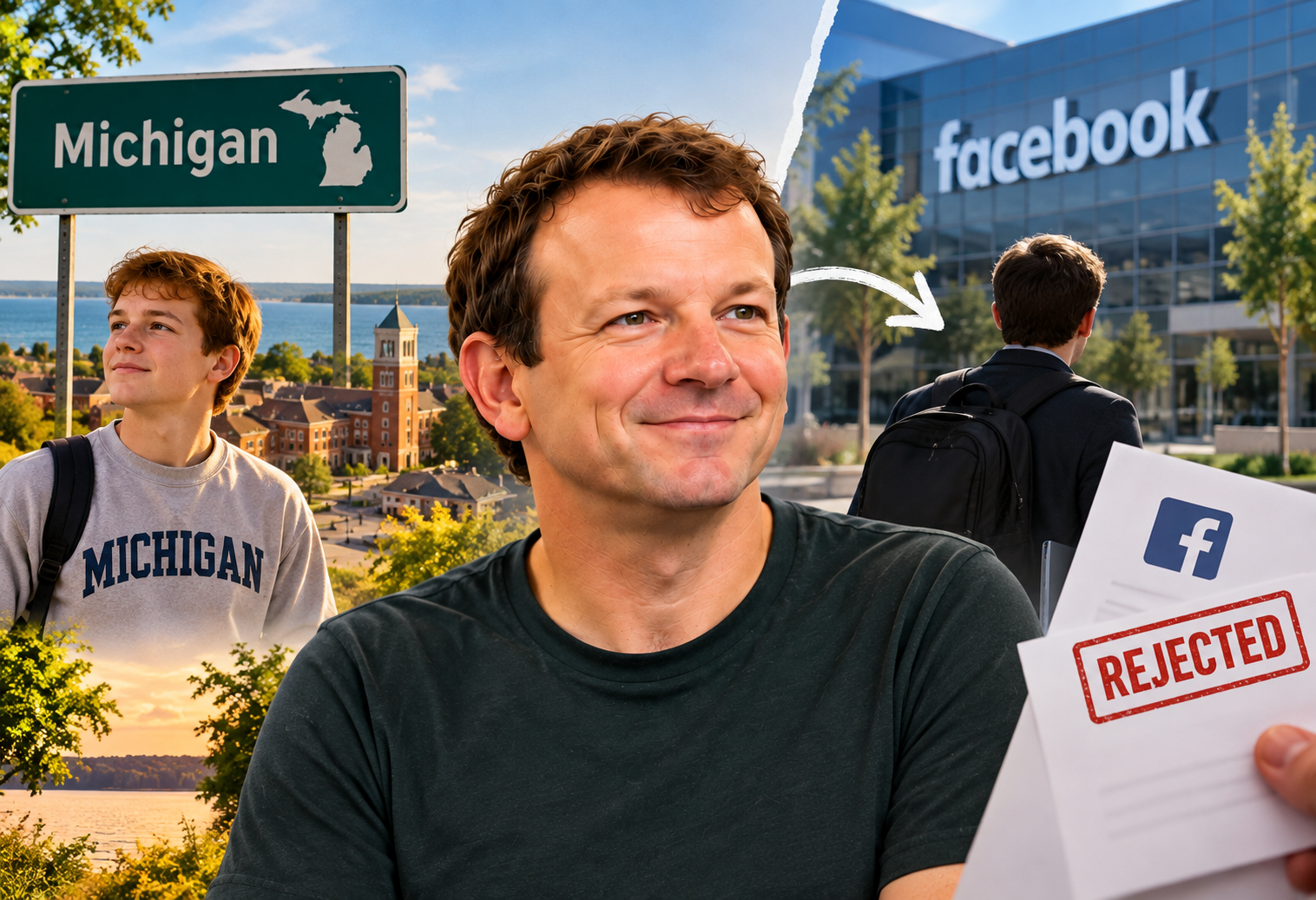
Brian Acton, co-founder of WhatsApp, grew up in Michigan before studying computer science at Stanford University. He spent over a decade at Yahoo, survived the dot-com crash, and was famously rejected by both Facebook and Twitter in 2009 before co-founding WhatsApp with Jan Koum. By 2026, his early career detours are widely cited as one of tech’s most instructive comeback stories.
Most founder stories skip straight to the big win. Brian Acton’s story is different, and more useful, because of everything that happened before WhatsApp existed. Long before he became a billionaire messaging-app entrepreneur, Acton was a Michigan-raised engineering student who built his career the slow way: one job, one rejection, and one lesson at a time.
Understanding Brian Acton’s early life matters because it reframes what “overnight success” actually looks like. His path included nearly twenty years of unglamorous engineering work, a stock options wipeout during the dot-com bust, and two humbling job rejections from companies that would go on to be his industry’s biggest players. This post walks through that early groundwork, and explains how it shaped the product decisions that eventually made WhatsApp one of the most valuable acquisitions in tech history.
Where did Brian Acton grow up and what was his educational background?
Brian Acton was born in 1972 and raised in Michigan, where he developed an early interest in computers and engineering. That interest carried him to Stanford University, where he earned a bachelor’s degree in computer science. Stanford’s computer science program placed him in close proximity to Silicon Valley’s growing tech scene just as the internet industry was beginning to take shape in the early 1990s.
This educational foundation gave Acton the technical grounding he would rely on for the next two decades, long before “software engineer” became a common job title outside the Bay Area.
What was Brian Acton’s career like before he worked at Yahoo?
After graduating from Stanford, Acton didn’t walk straight into a startup. He spent time working in quality assurance and infrastructure roles at well-known technology companies, including stints at Apple and Adobe Systems in the early-to-mid 1990s. These roles weren’t glamorous, but they taught him how large-scale software systems were tested, broken, and rebuilt, a skill set that would later prove essential for building a messaging app meant to run reliably on millions of devices.
How did Brian Acton’s time at Yahoo shape his engineering philosophy?
In 1996, Acton joined Yahoo, where he would spend the next 11 years. During this period, he met Jan Koum, the engineer who would later become his WhatsApp co-founder. The two worked together on Yahoo’s infrastructure and advertising systems, and their shared frustration with bloated, ad-driven products would later become central to WhatsApp’s “no ads, no games, no gimmicks” philosophy.
Acton’s Yahoo tenure also meant he experienced the dot-com crash from the inside. Like many employees who joined before the bust, he watched stock options lose most of their value as the market corrected. It was a formative lesson in how quickly tech valuations can shift, one he carried into his later approach toward product decisions and company culture.
Why did Facebook and Twitter reject Brian Acton for a job?
Perhaps the most widely referenced part of Brian Acton’s early career is his job search after leaving Yahoo in 2007. Acton applied for engineering positions at both Twitter and Facebook. Both companies turned him down.
The Facebook rejection is especially notable in hindsight: Facebook would go on to acquire WhatsApp for roughly $19 billion in 2014, and Acton would briefly serve on Facebook’s board before departing in 2017 over disagreements regarding data privacy and advertising strategy. Choose to view this rejection as a setback if you focus only on the short term, but for Acton, it became the push that led him toward building his own company instead of working for someone else’s.
How did Brian Acton end up co-founding WhatsApp?
After the rejections, Acton reconnected with Jan Koum, who had also left Yahoo. In 2009, the two co-founded WhatsApp with a simple goal: build a messaging app that didn’t rely on advertising or data harvesting to make money. Acton used part of his Yahoo severance and savings to help fund the early stages of the company, a financial risk that reflected the lessons he had absorbed from the dot-com downturn years earlier.
WhatsApp’s early traction came from word of mouth rather than marketing budgets, a strategy that mirrored the founders’ engineering-first, growth-second instincts from their Yahoo days.
Brian Acton’s early career timeline at a glance
| Year | Milestone |
|---|---|
| 1972 | Born and raised in Michigan |
| Early 1990s | Earns computer science degree from Stanford University |
| Mid-1990s | Works in engineering/QA roles at Apple and Adobe Systems |
| 1996 | Joins Yahoo; meets future WhatsApp co-founder Jan Koum |
| 2000–2001 | Experiences dot-com crash as a Yahoo employee |
| 2007 | Leaves Yahoo after 11 years; rejected by Facebook and Twitter |
| 2009 | Co-founds WhatsApp with Jan Koum |
| 2014 | WhatsApp acquired by Facebook for approximately $19 billion |
| 2018 | Co-founds the Signal Foundation after leaving Facebook’s board |
What can founders in 2026 and 2027 learn from Brian Acton’s early career?
For founders navigating today’s AI-driven startup landscape, Acton’s path offers a counterpoint to the “move fast and raise a seed round immediately” mindset. Choose the long-apprenticeship route if your product depends on deep technical reliability. Choose the faster, venture-backed route if your market window is closing quickly. Acton’s near-two-decade engineering background before founding WhatsApp gave him the infrastructure knowledge to scale a messaging app to hundreds of millions of users with a remarkably small team, a model still referenced in lean-startup discussions heading into 2027.
His later founding of the nonprofit Signal Foundation, built around encrypted messaging and user privacy, also shows a consistent throughline from his Yahoo and WhatsApp years: a preference for user trust over advertising revenue.
Brian Acton’s early life shows that setbacks can be redirections
Brian Acton’s story before WhatsApp wasn’t one of instant brilliance. It was two job rejections, a market crash, and nearly two decades of unglamorous engineering work that eventually gave him the credibility and technical judgment to build something massive. For anyone currently facing their own version of a Facebook or Twitter rejection letter, Acton’s trajectory is a reminder that the detour often becomes the foundation.
To see how that foundation translated into Acton’s current net worth and post-WhatsApp ventures, read the full breakdown on Brian Acton’s net worth and WhatsApp journey. For more founder paths shaped by early-career setbacks, check out Pieter Levels’ bootstrapped founder story and Marc Lou’s rise with ShipFast.
Frequently asked questions about Brian Acton’s early life
Where did Brian Acton grow up?
Brian Acton grew up in Michigan before attending Stanford University, where he studied computer science.
Did Brian Acton work anywhere before Yahoo?
Yes. Before his 11-year tenure at Yahoo, Acton held engineering and quality assurance roles at companies including Apple and Adobe Systems in the 1990s.
Why is Brian Acton’s rejection from Facebook significant?
Facebook rejected Acton for a job in 2009, yet the company later acquired his startup, WhatsApp, for roughly $19 billion in 2014, making the earlier rejection one of tech’s most cited ironic footnotes.
How long did Brian Acton work at Yahoo before starting WhatsApp?
Acton worked at Yahoo for 11 years, from 1996 to 2007, before leaving to eventually co-found WhatsApp with Jan Koum in 2009.
What did Brian Acton do after leaving Facebook’s board?
In 2018, Acton co-founded the nonprofit Signal Foundation, which supports the privacy-focused Signal messaging app, continuing the ad-free, privacy-first philosophy he developed during his Yahoo and WhatsApp years.
