
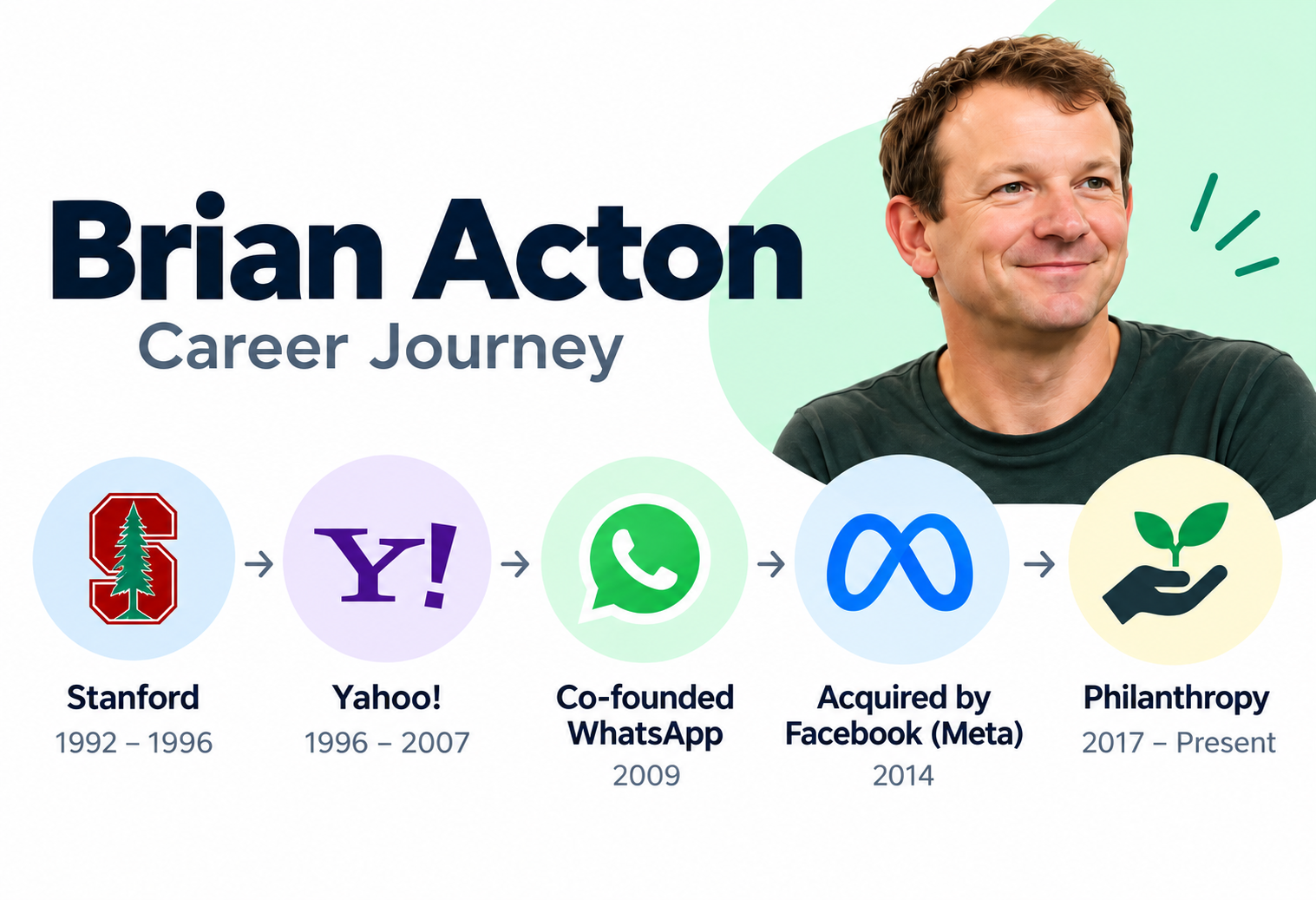
Brian Acton is the co-founder of WhatsApp and Signal Foundation, best known for building a messaging app that sold to Facebook for $19 billion in 2014. After leaving Facebook in 2017 over data privacy disagreements, Acton donated $50 million to help launch Signal, now one of the world’s most trusted encrypted messaging platforms. As of 2026, he remains Executive Chairman of the Signal Foundation.
Few career stories in tech carry the irony of Brian Acton’s. Rejected by both Facebook and Twitter for engineering jobs in 2009, Acton went on to co-found a company that Facebook would later acquire for $19 billion. That company was WhatsApp, and its founder’s path from job-seeker to billionaire remains one of Silicon Valley’s most quoted redemption arcs.
But Acton’s story doesn’t end with the WhatsApp sale. His decision to walk away from Facebook in 2017, forfeit hundreds of millions in unvested stock, and pour $50 million into a nonprofit encryption project reveals a founder whose priorities shifted dramatically once the money arrived. Understanding his full career—not just the WhatsApp windfall—explains why he’s still regarded as one of the tech industry’s most principled entrepreneurs heading into 2026 and 2027.
This post traces Brian Acton’s career chronologically, from his early years at Yahoo through the WhatsApp acquisition, his public break with Facebook, and his current work leading the Signal Foundation.
Table of Contents
Who Is Brian Acton and What Is He Known For?
Brian Acton is an American entrepreneur and software engineer best known for co-founding WhatsApp alongside Jan Koum in 2009. The two had previously worked together at Yahoo for roughly nine years before leaving to pursue new opportunities. WhatsApp grew into one of the world’s most widely used messaging apps, eventually reaching over 2 billion users globally before Acton’s departure from the company’s parent, Facebook (now Meta), in 2017.
Beyond WhatsApp, Acton is recognized for co-founding the nonprofit Signal Foundation in 2018, where he currently serves as Executive Chairman. He’s also known for publicly supporting the #DeleteFacebook movement after his split with the company, a move that generated significant media attention given his prior role as one of Facebook’s largest shareholders.
What Did Brian Acton Do Before Founding WhatsApp?
Before his entrepreneurial breakthrough, Acton spent close to 11 years at Yahoo in various engineering and infrastructure roles. During his tenure, he worked alongside Jan Koum, the colleague who would later become his WhatsApp co-founder. This long stretch at a single company gave Acton deep technical experience in building and scaling internet infrastructure—skills that proved directly applicable when he and Koum began building WhatsApp’s messaging backend years later.
After leaving Yahoo in 2007, Acton took time off, traveled, and reportedly applied for jobs at both Facebook and Twitter. Both companies turned him down. He later described this rejection publicly, and it’s become one of the most frequently cited anecdotes in startup folklore—a reminder that career setbacks don’t necessarily predict long-term outcomes.
How Did Brian Acton Co-Found WhatsApp?
In 2009, Acton reconnected with Koum, who was experimenting with an app that let users set custom status messages tied to their phone numbers. The two refined the concept into a messaging platform, and WhatsApp Inc. was officially founded that year. Acton joined as co-founder and took on responsibilities spanning business operations, marketing, and partnerships, while Koum focused heavily on engineering.
The app’s core pitch—simple, reliable, ad-free messaging—resonated internationally, particularly in markets where SMS costs were high. WhatsApp’s growth was almost entirely driven by word of mouth, without a conventional marketing budget. By 2013, the platform had surpassed 200 million monthly active users, a milestone that caught the attention of major tech acquirers.
Why Did Facebook Acquire WhatsApp for $19 Billion?
In February 2014, Facebook announced it would acquire WhatsApp for approximately $19 billion in cash and stock, making it one of the largest technology acquisitions in history at that time. Facebook’s interest centered on WhatsApp’s massive international user base and its potential to anchor Facebook’s push into mobile messaging and emerging markets.
Following the acquisition, Acton remained at Facebook in an executive role overseeing WhatsApp operations. His equity stake in the deal made him a billionaire, with Forbes later estimating his net worth in the billions of dollars. For readers interested in the full financial breakdown of how this deal shaped his wealth, Brian Acton’s net worth and the story of how WhatsApp made him a billionaire covers the details in depth.
Why Did Brian Acton Leave Facebook in 2017?
Acton departed Facebook in September 2017, reportedly over disagreements about WhatsApp’s monetization strategy, particularly proposals involving targeted advertising and loosened data encryption practices. By leaving before his equity fully vested, Acton forfeited an estimated $850 million in unvested stock—a decision he later said was necessary to align his exit with his principles on user privacy.
In 2018, Acton became an outspoken supporter of the #DeleteFacebook movement, publicly urging users to leave the platform following the Cambridge Analytica data scandal. This was a notable moment: a former Facebook executive and major shareholder actively encouraging people to abandon the platform he’d helped grow.
What Is Brian Acton’s Role at the Signal Foundation?
In February 2018, Acton co-founded the Signal Foundation alongside cryptographer Moxie Marlinspike, committing $50 million to fund the nonprofit’s mission of building accessible, open-source, end-to-end encrypted communication tools. Signal Messenger, the foundation’s flagship app, has since become one of the most trusted platforms for private communication, used by journalists, activists, and privacy-conscious consumers worldwide.
Acton serves as Executive Chairman of the Signal Foundation, a role he has held since its founding. Unlike WhatsApp, Signal operates as a nonprofit with no advertising or data-monetization model, reflecting the privacy values Acton has championed since leaving Facebook. Heading into 2026 and 2027, Signal continues to expand its user base amid growing global demand for encrypted messaging, particularly as governments and corporations face increased scrutiny over data practices.
Brian Acton’s Career Timeline at a Glance
| Year | Milestone |
|---|---|
| 1996–2007 | Works as a software engineer at Yahoo for approximately 11 years |
| 2009 | Rejected by Facebook and Twitter for engineering roles; co-founds WhatsApp with Jan Koum |
| 2013 | WhatsApp surpasses 200 million monthly active users |
| 2014 | Facebook acquires WhatsApp for approximately $19 billion |
| 2017 | Leaves Facebook, forfeiting an estimated $850 million in unvested stock |
| 2018 | Co-founds the Signal Foundation with Moxie Marlinspike; donates $50 million |
| 2018–2026 | Serves as Executive Chairman of the Signal Foundation, overseeing its nonprofit growth |
What Can Entrepreneurs Learn From Brian Acton’s Career?
Acton’s trajectory offers a useful case study for founders navigating their own paths. His story shows that early career rejection doesn’t close off future opportunities—it often redirects them toward better-fitting ventures. It also demonstrates that long tenure at a single company, like his 11 years at Yahoo, can build the technical depth needed to execute on a bigger idea later.
Perhaps most notably, Acton’s decision to leave hundreds of millions of dollars on the table at Facebook illustrates that founders can choose principle over payout when their values diverge from a company’s direction. Choose this path if long-term credibility and mission alignment matter more to you than maximizing short-term financial outcomes—it’s a decision that reshaped Acton’s public reputation and gave him a second act with Signal.
Other founders featured on this site took different routes to build lasting ventures. Marc Lou’s indie hacking approach with ShipFast shows how solo builders can scale fast without big funding rounds, while Pieter Levels’ bootstrapped empire offers another model of founder independence worth studying alongside Acton’s corporate-to-nonprofit pivot.
Where Brian Acton Stands Today
As of 2026, Brian Acton continues to lead the Signal Foundation’s mission to expand access to private communication tools worldwide. His estimated net worth remains in the multi-billion-dollar range, largely tied to his original WhatsApp equity, though he has redirected much of his public focus and philanthropy toward digital privacy advocacy rather than active startup building.
For those following his career closely, Acton’s public statements and the Signal Foundation’s official site remain the most reliable sources for updates on his current work. His Wikipedia profile also offers a well-documented record of his career milestones, while Forbes’ profile on Acton tracks his net worth estimates over time.
Acton’s career is a reminder that success in tech rarely follows a straight line—and that the choices founders make after they’ve “made it” often matter just as much as the breakthrough itself.
Frequently Asked Questions About Brian Acton
How much is Brian Acton worth in 2026?
Brian Acton’s net worth is estimated in the multi-billion-dollar range, primarily derived from his equity stake in WhatsApp’s $19 billion sale to Facebook in 2014. Exact figures fluctuate based on Meta’s stock performance and his philanthropic giving.
Why did Brian Acton leave Facebook?
Acton left Facebook in 2017 due to disagreements over WhatsApp’s monetization strategy, particularly plans involving targeted advertising and changes to data encryption practices that conflicted with his privacy principles.
What is Brian Acton doing now?
Brian Acton serves as Executive Chairman of the Signal Foundation, the nonprofit organization behind the Signal encrypted messaging app, a role he has held since co-founding the foundation in 2018.
Did Brian Acton found Signal alone?
No. Acton co-founded the Signal Foundation with cryptographer Moxie Marlinspike in 2018, contributing $50 million in initial funding to support the nonprofit’s development.
How long did Brian Acton work at Yahoo before WhatsApp?
Acton worked at Yahoo for approximately 11 years, from the mid-1990s until 2007, where he also met his future WhatsApp co-founder, Jan Koum.
