
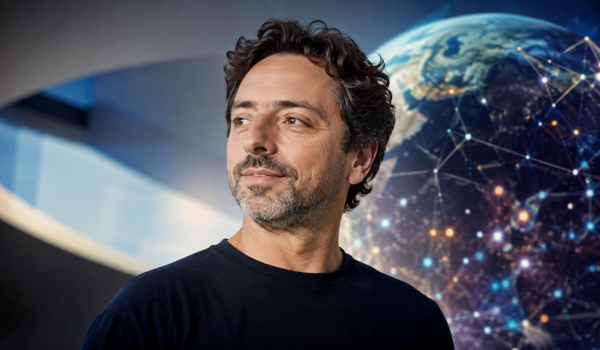
Sergey Brin is the Russian-American computer scientist who co-founded Google with Larry Page in 1998. Born in Moscow in 1973, Brin developed the foundational PageRank algorithm as a Stanford PhD student, transforming a research project into one of the most valuable companies in history. He later served as President of Alphabet Inc., Google’s parent company.
Few names carry as much weight in the technology industry as Sergey Brin. As the co-founder of Google, Brin helped build the engine that now processes more than 8.5 billion searches per day (according to Internet Live Stats). His story spans continents, academic breakthroughs, corporate revolutions, and personal reinvention—making it one of the most compelling in modern business history.
This biography covers Sergey Brin’s early life, his path through academia, the founding of Google, his leadership journey, his net worth, and the legacy he continues to shape. Whether you’re researching Silicon Valley history, studying entrepreneurship, or simply curious about the man behind the world’s most visited website, this guide covers it all.
Who Is Sergey Brin? A Quick Overview of His Life and Impact
Sergey Mikhailovich Brin was born on August 21, 1973, in Moscow, Russia (then the Soviet Union). He emigrated to the United States with his family at age six, settling in Maryland. His father, Michael Brin, was a mathematics professor at the University of Maryland, and his mother, Eugenia Brin, worked as a researcher at NASA’s Goddard Space Flight Center. That scientific household left a clear mark on the young Brin.
Brin showed exceptional aptitude for mathematics and computing from an early age. He earned his undergraduate degree in mathematics and computer science from the University of Maryland in 1993—graduating with honors at just 19. He then enrolled in Stanford University’s PhD program in computer science, where the course of internet history would change forever.
How Sergey Brin and Larry Page Met at Stanford and Built Google Together
Brin and Larry Page first met in 1995 during a campus orientation for incoming PhD students at Stanford. Page was visiting the campus; Brin was assigned to show him around. By most accounts, the two disagreed about nearly everything on that first day—but the intellectual friction sparked something. They became fast collaborators.
Their joint research project, which began in 1996, focused on developing a new kind of search engine. At the time, search engines ranked web pages based on how many times a keyword appeared in the content. Brin and Page believed that a page’s importance could be better measured by how many other pages linked to it—and how authoritative those linking pages were. This insight became the foundation of the PageRank algorithm, named after Larry Page.
Their early search engine was called “BackRub” before being renamed Google—a play on the word “googol,” which refers to the number 1 followed by 100 zeros. The name reflected their mission to organize an almost incomprehensible volume of web information. Google was officially incorporated on September 4, 1998. Brin and Page operated the company out of a garage in Menlo Park, California, rented from Susan Wojcicki, who would later become CEO of YouTube.
Sergey Brin’s Key Roles and Responsibilities at Google Over the Years
From the company’s earliest days, Brin and Page divided operational responsibilities. Page focused on product development and eventually took the CEO role, while Brin served as President of Technology. This division of labor shaped how Google functioned internally—with Page overseeing the product roadmap and Brin driving innovation, moonshot projects, and technical research.
Under Brin’s direction, Google launched some of its most ambitious initiatives, including Google X—the secretive research lab responsible for projects like self-driving cars (now Waymo), Google Glass, and Project Loon (high-altitude internet balloons). Brin took a particular interest in Google Glass, often appearing at public events wearing the augmented reality headset to generate buzz and signal Google’s ambitions beyond traditional software.
In 2011, Page returned as CEO of Google, and Brin shifted his focus toward these longer-horizon projects. He continued leading Google X and remained a key voice in shaping Google’s direction on artificial intelligence and hardware innovation.
How Alphabet Inc. Changed Sergey Brin’s Role and Expanded Google’s Ambitions
In August 2015, Google underwent a significant corporate restructuring. Larry Page and Sergey Brin announced the formation of Alphabet Inc., a new holding company that would serve as the parent organization for Google and its various subsidiaries. Google became just one of many companies under the Alphabet umbrella, which also included Waymo, DeepMind, Verily (life sciences), and Calico (longevity research).
Under this new structure, Larry Page became CEO of Alphabet, and Brin was named President of Alphabet. Sundar Pichai, who had been leading Google’s product efforts, became CEO of Google itself. The restructuring was designed to give each subsidiary more independence, clearer accountability, and the freedom to pursue its goals without being constrained by Google’s advertising-first culture.
Brin served as President of Alphabet until December 2019, when both he and Page stepped back from their executive roles. Sundar Pichai became CEO of both Google and Alphabet. Brin and Page retained their positions on the Alphabet board and remained its controlling shareholders through their ownership of Class B shares. In 2023, Brin returned to Alphabet’s AI efforts, reportedly working closely with Google DeepMind on the development of the Gemini AI model—signaling that his retirement from day-to-day operations hadn’t dimmed his technical ambitions.
A Data Table Showing Sergey Brin’s Life and Career Milestones at a Glance
| Year | Milestone |
|---|---|
| 1973 | Born in Moscow, Soviet Union, on August 21 |
| 1979 | Emigrated to the United States with his family |
| 1993 | Graduated from the University of Maryland with a BS in Mathematics and Computer Science |
| 1995 | Enrolled in Stanford University’s PhD program; met Larry Page |
| 1996 | Co-developed the PageRank algorithm with Larry Page |
| 1998 | Co-founded Google Inc. on September 4; company incorporated in California |
| 2004 | Google went public via IPO on the NASDAQ at $85 per share |
| 2005 | Google acquired Android Inc. for approximately $50 million |
| 2012 | Google acquired Motorola Mobility for $12.5 billion |
| 2015 | Co-founded Alphabet Inc.; named President of Alphabet |
| 2019 | Stepped down from Alphabet’s executive team |
| 2024 | Returned to active AI work with Google DeepMind on the Gemini model |
What Is Sergey Brin’s Net Worth and How Did He Build His Fortune?
Sergey Brin’s wealth is almost entirely tied to his ownership stake in Alphabet Inc. According to Forbes, Brin has consistently ranked among the ten wealthiest people on the planet. As of October 2026, his estimated net worth is more than $250 billion as of October 2026 (Forbes estimated about $260 billion on October 20, 2026; Bloomberg put it at about $274 billion on October 1), ranking him among the five richest people in the world. The figure moves with Alphabet’s stock price.
The bulk of his fortune stems from Google’s IPO in August 2004, when the company went public at $85 per share. At the time of the IPO, Brin held approximately 16% of Google’s shares. Alphabet’s stock has appreciated dramatically since then, fueled by Google’s dominance in search advertising, YouTube’s growth, Google Cloud’s expansion, and the increasing value of Waymo and DeepMind.
Outside of Alphabet, Brin has made private investments across a range of sectors, including biotech, clean energy, and aerospace. He has reportedly invested in companies working on aging research and longevity science—areas aligned with Alphabet’s Calico subsidiary. He is also known for funding research into Parkinson’s disease, partly motivated by the discovery that he carries the LRRK2 gene mutation, which increases his risk of developing the condition.
What Are Sergey Brin’s Views on Artificial Intelligence and the Future of Technology?
Brin’s return to active work at Google DeepMind in 2023 was widely interpreted as a signal of just how seriously he takes the AI transition.
Throughout his career, Brin has been candid about both the promise and the risks of emerging technology. He was an early advocate for open data, internet freedom, and the democratization of information—values that shaped Google’s early culture. At the same time, he has spoken openly about the responsibilities that come with building platforms at global scale.
His interest in AI extends beyond text and search. Brin’s work within Google X helped lay the groundwork for what is now Waymo, one of the most advanced autonomous vehicle programs in the world. He has also expressed enthusiasm for projects at the intersection of biology and computing, including early-stage research into brain-computer interfaces.
Sergey Brin’s Philanthropic Work and the Brin Wojcicki Foundation
Brin and his former wife, Anne Wojcicki (co-founder of the genetic testing company 23andMe), established the Brin Wojcicki Foundation to support scientific research and humanitarian causes. The foundation has contributed hundreds of millions of dollars to organizations focused on Parkinson’s disease research, education, poverty alleviation, and environmental conservation.
Unlike many tech billionaires, Brin has not signed the Giving Pledge; he gives mainly through his own family foundation, with a particular focus on Parkinson’s disease research. His Parkinson’s research funding, in particular, has helped accelerate clinical trials and genomic studies at institutions including the Michael J. Fox Foundation.
Sergey Brin’s Legacy and What He Means for the Future of Silicon Valley
Sergey Brin’s impact on technology extends well beyond Google’s search bar. The infrastructure he helped build now underpins global communication, digital commerce, cloud computing, and AI development. Google’s advertising model, which Brin helped shape, generated $237.86 billion in revenue in 2023, according to Alphabet’s annual report.
Beyond revenue, Brin’s approach to problem-solving—rooted in academic rigor, data-driven decision-making, and a willingness to pursue wildly ambitious ideas—became a template for Silicon Valley’s culture of “moonshot thinking.” Projects that seemed unrealistic in 2010, such as autonomous vehicles and AI assistants, are now mainstream industries.
His return to AI work at Google DeepMind suggests that the next chapter of his career may be defined not by building the internet’s infrastructure, but by shaping how artificial intelligence integrates into human life. Given his track record, that’s not a mission to take lightly.
Frequently Asked Questions About Sergey Brin
Who is Sergey Brin and what is he best known for?
Sergey Brin is a Russian-American computer scientist and entrepreneur best known for co-founding Google with Larry Page in 1998. He helped develop the PageRank algorithm and later served as President of Alphabet Inc., Google’s parent company.
Where was Sergey Brin born and when did he move to the United States?
Sergey Brin was born on August 21, 1973, in Moscow, Soviet Union. He moved to the United States in 1979 at the age of six, when his family emigrated to escape anti-Semitic discrimination.
What university did Sergey Brin attend, and did he finish his PhD?
Brin completed his undergraduate degree at the University of Maryland in 1993 and enrolled in Stanford University’s PhD program in computer science. He left Stanford to co-found Google without completing his doctorate—though Stanford later awarded him an honorary doctorate.
What is Sergey Brin’s estimated net worth in 2024?
As of October 2026, Sergey Brin’s net worth is estimated at more than $250 billion as of October 2026 (Forbes estimated about $260 billion on October 20, 2026; Bloomberg put it at about $274 billion on October 1). Most of his wealth is tied to his ownership stake in Alphabet Inc.
Why did Sergey Brin step down from Alphabet, and is he still involved?
Brin stepped down from Alphabet’s executive team in December 2019, alongside Larry Page. However, he has remained a major shareholder. In 2023, he returned to active involvement in Google’s AI efforts, working with Google DeepMind on the development of the Gemini AI model.
What is Sergey Brin’s connection to Parkinson’s disease research?
Brin discovered that he carries the LRRK2 gene mutation, which significantly increases the risk of developing Parkinson’s disease. This personal connection motivated him to fund substantial research into the condition through the Brin Wojcicki Foundation and partnerships with organizations like the Michael J. Fox Foundation.
What is the PageRank algorithm, and did Sergey Brin invent it?
The PageRank algorithm ranks web pages based on the number and quality of links pointing to them. Sergey Brin and Larry Page co-developed PageRank at Stanford University in 1996. The algorithm became the foundation of Google’s original search engine and transformed how the web was indexed and navigated.
Related Founder Stories
- Sergey Brin Net Worth 2026: How Google’s Co-Founder Built His Billions
- Larry Page: The Google Co-Founder Who Rewired the Internet
- Susan Wojcicki: The Woman Who Built YouTube Into a Global Giant
- Anne Wojcicki’s Wild Ride: How She Built 23andMe Into a Genetic Testing Giant, Then Watched It Collapse
- Who Is Urs Hölzle and Why Does He Matter to the Internet?
