
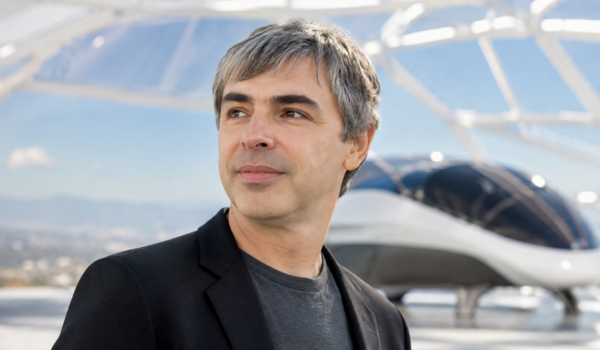
Larry Page, co-founder of Google and former CEO of Alphabet Inc., has a net worth estimated at approximately $130 billion as of 2025, making him one of the wealthiest people on Earth. His fortune stems primarily from his equity stake in Alphabet, supplemented by investments in moonshot ventures, aviation startups, and clean energy projects.
Few wealth stories in modern business history are as compelling as Larry Page’s. A computer science PhD student at Stanford University in the mid-1990s, Page teamed up with fellow researcher Sergey Brin to build a search engine that would go on to reshape how the entire world accesses information. What started as a research project called “Backrub” became Google—and Google became one of the most valuable companies ever created.
Today, Larry Page’s net worth places him firmly among the world’s top five wealthiest individuals. But the number itself is only part of the story. Understanding how Page built, sustained, and continues to grow his fortune requires looking at the full arc of his career: from a dorm-room project at Stanford to the architectural decisions that transformed Google into Alphabet, a multi-industry holding company with fingers in everything from self-driving cars to quantum computing.
This post breaks down Larry Page’s net worth in detail, examines the key wealth drivers behind his fortune, and explores what he’s doing with that money today.
What Is Larry Page’s Net Worth in 2025 and How Is It Calculated?
As of 2025, Larry Page’s net worth is estimated at approximately $130 billion, according to Forbes and Bloomberg Billionaires Index tracking. This figure fluctuates regularly, tied closely to the performance of Alphabet Inc. (NASDAQ: GOOGL), in which Page holds a significant equity stake.
Page owns roughly 5.7% of Alphabet’s total shares. Given that Alphabet’s market capitalization has consistently hovered between $1.8 trillion and $2.3 trillion in recent years, even small movements in the stock price can shift Page’s personal wealth by billions of dollars in a single trading session. This is a dynamic that applies to most ultra-high-net-worth individuals whose fortunes are tied to publicly listed companies—their stated net worth is, in a sense, a real-time estimate rather than a fixed number.
Beyond Alphabet stock, Page holds investments through his family office and personal venture portfolio. These include stakes in aviation technology companies, renewable energy initiatives, and various early-stage startups. While these assets are not publicly disclosed in full, wealth researchers and financial journalists have documented several high-profile investments that contribute meaningfully to his overall financial picture.
For more net worth analysis and in-depth profiles of the world’s wealthiest tech figures, Trafily covers a wide range of billionaire and entrepreneur breakdowns worth exploring.
How Did Larry Page Make His Money? The Origins of the Google Fortune
Larry Page’s wealth has one central source: Google. But the path from idea to billions was neither linear nor guaranteed.
Page was born on March 26, 1973, in East Lansing, Michigan, into an academic household. His father, Carl Page, was a computer science professor at Michigan State University, and his mother taught computer programming. Technology was not just a hobby in the Page household—it was the family trade. Larry Page grew up surrounded by computers and science magazines, an environment that clearly shaped his future.
He completed his undergraduate degree in computer engineering at the University of Michigan before enrolling in Stanford’s computer science PhD program in 1995. It was there that he met Sergey Brin. Their collaboration on a search algorithm that ranked web pages based on the number and quality of links pointing to them—a concept they called PageRank—became the technical foundation of Google.
Google was officially incorporated on September 4, 1998, in a Menlo Park garage. Page and Brin each held roughly equal equity stakes at founding. The company grew at a pace that surprised even its founders. By the time Google went public on August 19, 2004, at an IPO price of $85 per share, Page’s stake was worth hundreds of millions of dollars. The stock has since split multiple times and appreciated dramatically—today, adjusted for splits, those original $85 shares represent a return that few investments in history can match.
What Role Did the Alphabet Restructuring Play in Growing Larry Page’s Fortune?
In August 2015, Larry Page made one of the most consequential structural decisions of his career: he reorganized Google into a new parent company called Alphabet Inc. Under this new structure, Google became a subsidiary of Alphabet alongside a collection of other ambitious ventures—Waymo (self-driving vehicles), Verily (life sciences), DeepMind (artificial intelligence), Wing (drone delivery), and more.
Page became Alphabet’s CEO, with Sundar Pichai taking over as CEO of Google. The restructuring was not just administrative. It was a signal of how Page viewed the company’s future: as a portfolio of long-term bets, not a single product business. This strategic clarity resonated with investors. Alphabet’s market cap grew substantially in the years following the restructuring, amplifying Page’s personal wealth in the process.
Page stepped down as Alphabet’s CEO in December 2019, handing the role to Sundar Pichai permanently. He remains a board member and controlling shareholder, with his Class B shares carrying ten votes each—a structure that ensures Page and Brin retain effective voting control over the company regardless of how many shares they sell.
What Are Larry Page’s Key Investments Outside of Alphabet?
Larry Page has channeled a portion of his wealth into ventures far removed from search engines and advertising. Several of these investments have attracted significant public attention.
Aviation and Flying Cars: Page was a prominent early backer of Kitty Hawk, an electric aviation startup founded by Sebastian Thrun. Kitty Hawk worked on vertical takeoff and landing (VTOL) aircraft before shutting down in 2022. Page was also linked to Opener, another electric aircraft company working on autonomous air vehicles. These investments reflect a genuine personal passion—Page holds a pilot’s license and has spoken publicly about his enthusiasm for aviation technology.
Clean Energy: Page has expressed strong interest in nuclear fusion and other clean energy technologies. He is reported to have invested in Tri Alpha Energy (now TAE Technologies), a private fusion energy company. While fusion remains commercially unproven, TAE has raised substantial funding and continues to attract serious scientific and financial attention.
Early-Stage Venture Capital: Through his family office structure, Page has participated in funding rounds for various technology startups. The full scope of these investments is not publicly disclosed, but the pattern suggests a preference for transformative, long-horizon technology bets rather than short-term returns.
For those interested in the intersection of technology, SEO, and digital growth strategies, LinkLuminous offers expert link-building and marketing services that help brands build authority in competitive spaces—a useful resource for anyone looking to scale their digital presence the right way.
How Does Larry Page Spend His Wealth and Where Does He Live?
Larry Page is notably private for someone of his stature. He does not maintain a high public profile, rarely gives interviews, and has largely stepped away from the tech industry’s conference circuit. This makes piecing together details of his lifestyle more difficult than it might be for other billionaires.
What is documented: Page owns substantial real estate, including properties in the San Francisco Bay Area and a large estate in New Zealand. The New Zealand connection is particularly notable—Page acquired residency status there, part of a broader pattern of ultra-wealthy individuals seeking residence in politically stable, geographically remote locations.
He is also known to own a superyacht, reportedly a vessel called Senses, and several private aircraft, consistent with his aviation interests. His philanthropic activity, while less publicized than that of Bill Gates or Warren Buffett, includes contributions through the Carl Victor Page Memorial Foundation, named after his father. The foundation has supported education, health, and scientific research initiatives.
Page and his wife, Lucinda Southworth (a research scientist), have been married since 2007. They are rarely seen at public events, a deliberate choice that sets Page apart from many of his Silicon Valley peers.
How Does Larry Page’s Net Worth Compare to Other Tech Billionaires in 2025?
To put Larry Page’s $130 billion net worth in context, it helps to compare him to the other giants of the tech era.
Elon Musk, whose wealth is tied to Tesla, SpaceX, and X (formerly Twitter), has held the top spot on the global billionaire rankings for much of the past three years, with a net worth that has ranged from $180 billion to over $300 billion depending on market conditions. Jeff Bezos, founder of Amazon, consistently ranks near the top with a fortune estimated above $170 billion. Bill Gates, despite decades of philanthropic giving, retains a net worth exceeding $100 billion. Mark Zuckerberg, CEO of Meta Platforms, has seen his wealth surge past $150 billion following Meta’s aggressive AI and advertising growth.
Page sits comfortably in this tier. His fortune is less volatile than Musk’s (which swings dramatically with Tesla and SpaceX valuations) and more concentrated than Bezos’s diversified holdings. The core of Page’s wealth—Alphabet stock—is a stable, cash-generating asset backed by Google’s dominant position in search, advertising, cloud computing, and AI.
For detailed tech industry insights and business news across emerging markets, TechBullion is a valuable resource covering innovation, startups, and entrepreneurship stories worth following.
What Is the Future Outlook for Larry Page’s Wealth as Alphabet Expands Into AI?
Alphabet’s aggressive expansion into artificial intelligence presents the most significant variable in Larry Page’s future net worth trajectory. Google DeepMind—formed from the merger of Google Brain and DeepMind in 2023—is now one of the world’s leading AI research organizations. Alphabet’s Gemini AI model competes directly with OpenAI’s GPT-4 and Anthropic’s Claude for dominance in large language model applications.
AI represents both a risk and an opportunity for Alphabet. On one hand, AI-powered search competitors and changing user behavior could erode Google’s advertising revenue. On the other hand, Alphabet’s infrastructure advantages, proprietary data, and research depth position it to remain a central player in the AI era rather than a casualty of it. Sundar Pichai has committed Alphabet to aggressive AI investment, and the market has responded positively.
If Alphabet successfully navigates the AI transition and continues to grow its cloud and advertising businesses, Page’s equity stake could appreciate substantially over the next decade. Conversely, regulatory pressure—particularly from the U.S. Department of Justice’s antitrust actions against Google’s search monopoly—poses a genuine structural risk that could affect the company’s valuation and, by extension, Page’s net worth.
Larry Page’s Net Worth: Key Takeaways and What His Story Reveals About Wealth Building at Scale
Larry Page’s fortune is a product of timing, technical brilliance, strategic structure, and extraordinary patience. He and Sergey Brin identified a problem—web search was broken—and built a solution that was so much better than anything else available that it became essential infrastructure for the modern internet.
The decision to restructure as Alphabet in 2015 extended that foundational advantage into new industries. The decision to build with a dual-class share structure ensured that Page and Brin retained control even as they diluted their ownership through employee compensation and fundraising. These were not accidental outcomes. They reflect a deliberate approach to building durable wealth, not just a fast-growing company.
At $130 billion, Larry Page’s net worth stands as one of the clearest examples of what happens when a genuinely transformative product meets patient, long-term thinking. He is not the world’s richest person. But his story remains one of the most instructive in the history of technology entrepreneurship.
Frequently Asked Questions About Larry Page’s Net Worth
What is Larry Page’s net worth in 2025?
Larry Page’s net worth is estimated at approximately $130 billion as of 2025, based on his equity stake in Alphabet Inc. and other known investments. This figure is tracked by Forbes and the Bloomberg Billionaires Index and changes with Alphabet’s stock price.
How did Larry Page become so wealthy?
Larry Page co-founded Google in 1998 with Sergey Brin. The company’s dominance in search advertising, cloud computing, and digital services made it one of the most valuable businesses in history. Page’s approximately 5.7% equity stake in Alphabet, Google’s parent company, is the primary source of his wealth.
Does Larry Page still own Google stock?
Yes. Larry Page retains a significant ownership stake in Alphabet Inc., the parent company of Google. He holds Class B shares, which carry ten votes each, giving him and Sergey Brin effective voting control over the company.
What does Larry Page invest in outside of Alphabet?
Outside of Alphabet, Larry Page has invested in electric aviation startups (including Kitty Hawk and Opener), clean energy technology (including TAE Technologies, a nuclear fusion company), and various early-stage technology ventures through his family office.
Is Larry Page richer than Sergey Brin?
Larry Page and Sergey Brin hold similar equity stakes in Alphabet and have comparable net worths. As of 2025, their fortunes are both estimated in the range of $120–$135 billion, with minor differences depending on the timing of share sales and other asset valuations.
Why did Larry Page step down as Alphabet CEO?
Larry Page stepped down as CEO of Alphabet in December 2019, with Sundar Pichai taking over the combined role of Google and Alphabet CEO. Page cited a desire for Alphabet’s management structure to scale more efficiently. He remains a board member and controlling shareholder.
