
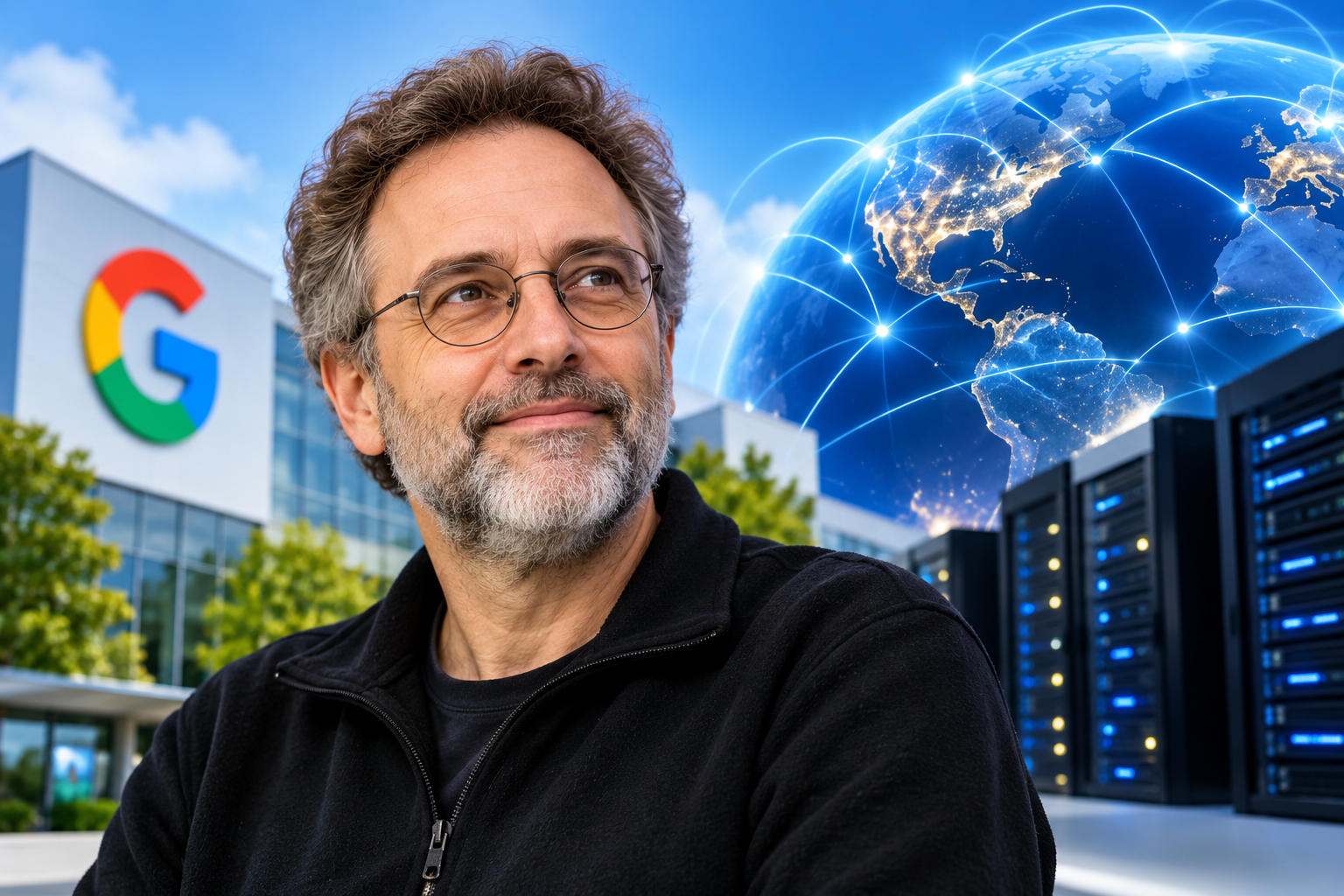
Quick answer: Urs Hölzle is a Swiss computer scientist and Google’s eighth employee, widely recognized as the architect of Google’s global technical infrastructure. As Senior Vice President of Technical Infrastructure, Hölzle oversaw the systems that power Google Search, YouTube, Gmail, and Google Cloud—making him one of the most influential engineers in the history of the internet.
Urs Hölzle’s name rarely appears in mainstream headlines. He doesn’t make product announcements on a big stage or post viral opinions on social media. Yet the infrastructure he built and led at Google for over two decades quietly underpins billions of searches, emails, video streams, and cloud workloads every single day.
His story is one of technical brilliance meeting institutional trust. Hölzle joined Google in 1999, before the company had gone public, before Gmail existed, and long before “the cloud” was a phrase anyone used at work. What followed was a career that shaped how the entire technology industry thinks about large-scale computing.
This post covers who Urs Hölzle is, what he built at Google, and why his work remains relevant for anyone interested in technology, infrastructure, or the future of the internet.
Table of Contents
Who Is Urs Hölzle? A Full Biography and Background
Urs Hölzle was born in Switzerland and earned his undergraduate degree from ETH Zurich, one of Europe’s most respected technical universities. He later completed his Ph.D. in computer science at Stanford University, where his research focused on programming languages and optimizing compilers—specifically, making programs run faster without changing what they do.
His academic work on the Self programming language and dynamic compilation laid the groundwork for techniques now used in modern JavaScript engines and virtual machines. Long before he was building planet-scale server farms, Hölzle was solving deep problems in how software executes.
After Stanford, he joined the University of California, Santa Barbara as a professor. That academic path took a sharp turn in 1999 when Larry Page and Sergey Brin recruited him to become Google’s first VP of Engineering—the eighth employee overall. At the time, Google was running off a handful of servers in a garage. Within a few years, it would become the most visited site on the internet. Hölzle was the person building the foundation that made that scale possible.
What Role Did Urs Hölzle Play at Google Over the Years?
| Year | Role / Milestone |
|---|---|
| 1999 | Joined Google as VP of Engineering (Employee #8) |
| Early 2000s | Led infrastructure scaling for Google Search |
| 2005–2010 | Oversaw global data center expansion |
| 2011 | Google announced commitment to renewable energy, led by Hölzle |
| 2013 | Promoted to Senior Vice President of Technical Infrastructure |
| 2020 | Google achieves 24/7 carbon-free energy goal in some data centers |
| 2022 | Hölzle steps back from day-to-day VP role |
Hölzle’s tenure at Google spans one of the most rapid technological expansions in business history. He moved from managing a few servers to overseeing one of the largest computing networks ever built.
His responsibilities included Google’s data centers, networking, hardware design, energy strategy, and the technical foundation for Google Cloud. According to Google, Hölzle holds over 30 patents related to computing infrastructure and energy efficiency.
How Did Urs Hölzle Build Google’s Technical Infrastructure from Scratch?
This is where the story gets genuinely remarkable. When Hölzle arrived at Google, the company had no scalable infrastructure plan. Search queries were growing exponentially, and the systems in place could not keep up.
Rather than buying expensive proprietary hardware from established vendors, Hölzle championed a different model: build custom servers from commodity components, design them for failure tolerance, and write software that treats hardware failures as routine rather than catastrophic. This philosophy—now commonplace across big tech—was radical at the time.
He introduced a culture of treating infrastructure as a product. Google’s data centers, under his direction, became engineering assets rather than just facilities. The team designed custom chips, built proprietary networking switches, and eventually created TPUs (Tensor Processing Units) to accelerate machine learning workloads.
Google’s Jupiter network fabric, Andromeda software-defined networking, and the Maglev load balancer—all of these systems trace their lineage to the infrastructure culture Hölzle established. For those curious about how large-scale digital infrastructure gets built and maintained, Trafily’s coverage of tech leaders and builders offers useful context on the broader ecosystem.
What Is Urs Hölzle’s Net Worth and Financial Standing?
Hölzle joined Google as employee number eight. Early employees who held equity through Google’s 2004 IPO—when shares opened at $85 and climbed steeply over the following years—accumulated substantial wealth. While Hölzle has not publicly disclosed his precise net worth, financial analysts and tech observers widely estimate his net worth to be in the range of $1 billion to $2 billion, based on his tenure, equity holdings, and stock performance over two decades.
It is worth noting that these figures are estimates derived from public filings and compensation disclosures, not confirmed personal statements. Google’s stock (traded as Alphabet Inc., GOOG) rose from an adjusted price of roughly $2.50 at IPO in 2004 to over $150 by 2024—a gain of more than 6,000%.
| Metric | Estimate |
|---|---|
| Google Joining Year | 1999 |
| Employee Number | #8 |
| Estimated Net Worth | $1B–$2B (analyst estimates) |
| Patents Held | 30+ |
| Years at Google | 23+ |
How Did Urs Hölzle Champion Renewable Energy at Google?
One of Hölzle’s most lasting contributions goes beyond code and servers. He became a leading voice for sustainable data center operations at a time when few technology companies were discussing energy consumption at all.
Data centers consume enormous amounts of electricity. A single large facility can draw as much power as a small city. Hölzle recognized this early and pushed Google to take responsibility for its energy footprint.
In 2010, Google became the first major company to make a large-scale renewable energy purchase agreement (PPA) for wind power. Hölzle led and championed this effort. By 2017, Google matched 100% of its global electricity consumption with renewable energy purchases—the first major company of its size to do so, according to Google’s official sustainability reports.
Hölzle then pushed further, targeting what he described as “24/7 carbon-free energy”—meaning every hour of every day powered by clean energy, not just an annual average match. This is a significantly harder goal than annual matching and remains an industry benchmark. For businesses looking to understand how digital infrastructure and sustainability intersect, resources like LinkLuminous offer insight into how technology companies build and communicate their digital presence responsibly.
What Is Google’s Technical Infrastructure and Why Does It Matter for Google Cloud?
Hölzle’s work was not confined to keeping Google’s own services running. The infrastructure he built became the foundation for Google Cloud Platform (GCP), which competes with Amazon Web Services (AWS) and Microsoft Azure.
Google Cloud is now a multi-billion dollar business. In Q1 2024, Google Cloud generated $9.6 billion in revenue, according to Alphabet’s official earnings report—representing 28% year-over-year growth. That business runs on the same infrastructure principles Hölzle established in the early 2000s.
| Cloud Platform | Q1 2024 Revenue | Market Share (Est.) |
|---|---|---|
| Amazon Web Services | $25.0 billion | ~31% |
| Microsoft Azure | ~$26.7 billion | ~25% |
| Google Cloud | $9.6 billion | ~11% |
Source: Synergy Research Group, Alphabet Q1 2024 Earnings
Hölzle served on the Google Cloud leadership team and helped position GCP as a technically differentiated option—particularly for AI and machine learning workloads, areas where Google’s TPU chips provide measurable performance advantages.
What Are Urs Hölzle’s Key Technical Contributions and Patents?
Hölzle’s technical fingerprints appear across multiple layers of modern computing. Some of his most significant contributions include:
- Dynamic compilation techniques — derived from his Ph.D. research, these methods influence how modern programming languages execute code efficiently
- Custom server hardware design — Google’s decision to build its own servers, rather than buy from vendors like HP or Dell, was formalized under his leadership
- Data center cooling innovation — Google pioneered the use of outside air, evaporative cooling, and hot aisle containment under Hölzle’s infrastructure program
- TPU development — Tensor Processing Units, Google’s custom chips for AI, were developed within the infrastructure organization he oversaw
- Renewable energy PPAs — Hölzle helped establish the corporate PPA model now widely adopted across the technology industry
These contributions extend well beyond Google. The custom server model influenced Meta, Microsoft, and Amazon. The renewable energy PPA model is now standard practice for large technology companies worldwide.
For those researching how companies build authoritative digital footprints around technical content, LinkLuminous specializes in link building strategies that help websites gain visibility in competitive verticals.
What Happened When Urs Hölzle Left His Day-to-Day Role at Google?
In 2022, Google announced a restructuring of its infrastructure leadership. Hölzle transitioned away from his day-to-day SVP role, with Amin Vahdat taking over many of the operational infrastructure responsibilities. Hölzle moved into a senior advisory and fellow-level position.
This type of transition is common for long-tenured technical leaders at large technology companies. It allows them to contribute to strategic and research-oriented work without being accountable for daily operations. Hölzle has remained affiliated with Google and continues to be cited as a key architect of the company’s infrastructure legacy.
His departure from the operational role coincided with Google’s increased focus on AI infrastructure—an area where the foundations he laid, particularly around TPUs and large-scale distributed computing, became more important than ever.
What Can Other Companies Learn from Urs Hölzle’s Approach to Infrastructure?
Hölzle’s career offers several lessons that apply beyond Google:
Build for failure, not against it. Google’s infrastructure treats hardware failure as a certainty, not an exception. Software compensates automatically. This philosophy reduces downtime and eliminates dependence on expensive, fault-resistant hardware.
Own your supply chain where it matters. By designing custom chips and servers, Google gained performance advantages and cost control that off-the-shelf hardware could not provide.
Treat sustainability as an engineering problem. Hölzle approached renewable energy not as a PR initiative but as a technical and operational challenge with measurable outcomes.
Infrastructure is a product. Hölzle consistently treated internal systems with the same rigor as external-facing products—clear ownership, performance metrics, and continuous improvement.
These principles now influence how companies across sectors think about digital infrastructure. Resources like Trafily track how technology leaders apply these ideas in practice, particularly as AI reshapes computing demands. For additional coverage of infrastructure, tech business strategy, and digital transformation, TechBullion covers the intersection of technology and business growth.
Frequently Asked Questions About Urs Hölzle
Who is Urs Hölzle and what is he known for?
Urs Hölzle is a Swiss computer scientist and Google’s eighth employee. He served as Senior Vice President of Technical Infrastructure at Google for over two decades, overseeing the systems that power Google Search, Gmail, YouTube, and Google Cloud. He is widely recognized as the architect of Google’s global computing infrastructure.
What is Urs Hölzle’s estimated net worth?
Based on analyst estimates and his tenure as one of Google’s earliest employees with significant equity holdings, Urs Hölzle’s net worth is estimated at between $1 billion and $2 billion. These are estimates based on public disclosures, not confirmed personal figures.
Is Urs Hölzle still at Google?
As of the most recent public information available, Hölzle transitioned out of his day-to-day SVP role in 2022 but remained affiliated with Google in a senior advisory capacity. He is no longer managing daily infrastructure operations.
What is Urs Hölzle’s educational background?
Hölzle earned his undergraduate degree from ETH Zurich in Switzerland and completed his Ph.D. in computer science at Stanford University. His doctoral research focused on programming language optimization and dynamic compilation.
What did Urs Hölzle contribute to renewable energy?
Hölzle led Google’s push to purchase renewable energy at scale, resulting in Google becoming the first major company to match 100% of its global electricity consumption with renewable energy in 2017. He later championed the more ambitious “24/7 carbon-free energy” goal, which targets clean energy use for every hour of every day.
How did Urs Hölzle influence Google Cloud?
The technical infrastructure Hölzle built for Google’s internal services—including custom hardware, proprietary networking, and TPU chips—became the foundation for Google Cloud Platform. His infrastructure culture and engineering philosophy directly shaped GCP’s technical differentiation.
The Quiet Engineer Who Built the Internet’s Backbone
Urs Hölzle represents a category of technologist that rarely gets enough recognition: the builder. Not the founder, not the marketer, not the public face—but the person who figures out how to make something work at a scale no one has attempted before.
Google’s ability to handle billions of queries per day, stream hundreds of hours of video every second, and offer competitive cloud computing services to enterprises worldwide traces back to the infrastructure philosophy Hölzle established before most of those products even existed.
His legacy is not a single product launch. It is the invisible foundation that makes everything else possible.
